· ReadyStack
Worked example
Real numbers from this tool, line by line.
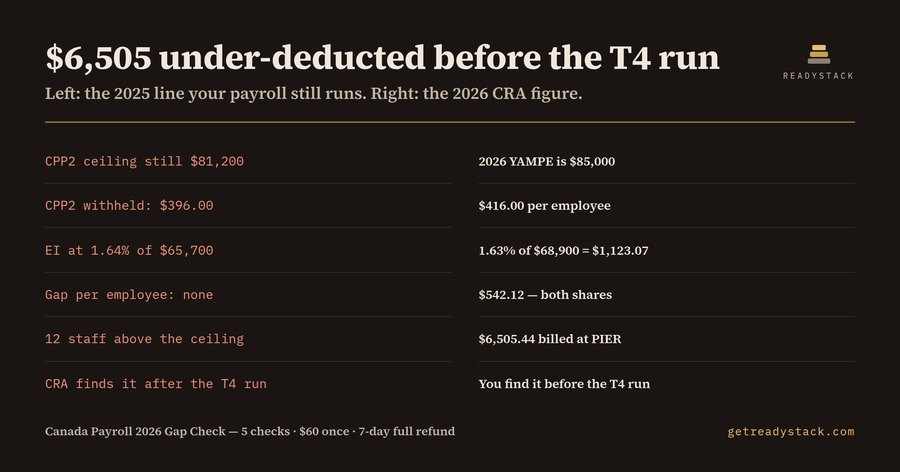
A Toronto agency with 12 people above the first CPP ceiling is $6,505 short on the year, and its bookkeeper has no idea — the payroll spreadsheet is still keyed to the 2025 tables.
That is 2026 Canadian payroll in one line: the ceilings moved, the spreadsheets did not, and the gap is small enough per cheque that nobody catches it until CRA does the arithmetic for you.
Here is what changed. For 2026 the first ceiling, the Year's Maximum Pensionable Earnings, is $74,600, up from $71,300. The second ceiling, the YAMPE that CPP2 runs to, is $85,000, up from $81,200. Employment Insurance maximum insurable earnings are $68,900, up from $65,700, and the employee premium rate dropped a cent to 1.63% outside Quebec, 1.30% for Quebec workers under QPIP. Run one salary through both years. At $92,000, outside Quebec, the 2026 answer is CPP $4,230.45, CPP2 $416.00 and EI $1,123.07 — $221.90 on a cheque paid every two weeks. The 2025 tables say CPP $4,034.10, CPP2 $396.00 and EI $1,077.48. The difference is $261.94 for the year — ten dollars a cheque. Nobody notices ten dollars.
What matters is what CRA does with it. After T4 slips are filed — the deadline is the last day of February 2027 — the Pensionable and Insurable Earnings Review compares what you remitted against what the slips say you should have. When there is a shortfall, the PIER assessment covers the employee portion as well as the employer portion. You do not get to go back and take it off the employee's next cheque; the employer wears both. So the $261.94 per person becomes $542.12: the CPP shortfall of $216.35 counted twice for the match, plus $45.59 of employee EI and $63.83 of employer EI at 1.4 times. Twelve people above the ceiling, and that is $6,505.44. The PIER package gives you 30 days to reply.
The shape of the exposure is not intuitive, which is why a rule of thumb does not work here. A $78,000 salary sits only $3,400 into the CPP2 band, so the gap per head falls to $238.12 — but across 40 staff that is $9,524.80, more than the agency with the bigger salaries. A Montreal shop on the QPIP rate paying $92,000 monthly to 3 people lands at $516.77 each, $1,550.31 in total. Same law, three different answers.
Ask a chatbot and you will be told the 2025 ceilings with complete confidence, because that is what it was trained on. Free online calculators have the same problem, one year behind, and none of them multiply the difference across your staff or mention that the employer is assessed for both shares.
So I built the thing that does. Canada Payroll 2026 Gap Check is a browser extension — one zip for Chrome, Edge and Firefox — and the same tool runs as a web page with no install. You type a salary, the pay periods, whether you are in Quebec, and how many people sit above the first ceiling, and you get the 2026 CPP, CPP2 and EI amounts for employee and employer, the per-cheque deduction, and the PIER exposure per employee and across the roster. Untick the stale-tables box and the exposure goes to zero, which is what a fixed payroll looks like.
All of that is free: no key, no limit, no watermark, no locked answer. The $60 licence key adds one thing on a different axis — the CSV export, one row per employee, a file you own and attach to a payroll correction or a PIER reply. A freelance bookkeeper in Canada charges $30 to $90 an hour, and rebuilding a year of CPP and EI figures by hand is not a ten-minute job.
Every figure above came from the CRA rate pages and the Employment Insurance Commission's 2026 premium announcement, checked on 2026-09-16.
15 seconds — what it actually does
Full walk-through
Questions people ask
What does this actually work out?
It runs 5 checks on one annual salary and returns the 2026 CPP, CPP2 and EI amounts for the employee and the employer, the deduction that belongs on a single cheque, and the dollar gap left behind if payroll is still keyed to the 2025 ceilings. At $92,000 with 12 staff above the first ceiling, the gap is $6,505.
Who is it for?
Canadian small-business owners, bookkeepers and payroll admins who run payroll in a spreadsheet or key deductions into accounting software by hand, and anyone preparing T4 slips who wants CPP and EI to reconcile before CRA does the same arithmetic in a PIER review.
Why not just ask a chatbot or use a free online calculator?
Both answer with the ceilings they were trained on, which are usually 2025: a YMPE of $71,300, a YAMPE of $81,200 and maximum insurable earnings of $65,700. Those numbers are wrong for 2026 and the error is small enough per cheque that nobody notices it until the T4 run.
What is free and what does the key add?
Every calculation is free with no key, no limit and no watermark, in the popup and in the browser page. The $60 licence key adds one thing on a different axis: exporting the roster as a CSV file you own and can attach to a payroll correction or a PIER reply.
What would this cost me otherwise?
A freelance bookkeeper in Canada charges $30 to $90 an hour, and rebuilding a year of CPP and EI figures for a PIER reply is not a ten-minute job. CRA gives you 30 days to answer a PIER package, and the assessment covers the employer share as well as the employee share.
Ask about this tool
One question, answered by the person who built it. Your email only if you want the answer sent.